Category Archives: Writing

One week to go…

Anywhere But Here comes out a week from today! Yikes!

I am (a) worrying that everyone I know is going to read the book and wonder why in the world I’m writing rather than waiting tables, which is obviously my true calling in life; and (b) worrying that there are things I should be doing to mark its arrival.

Unfortunately, I can’t figure out what those things might be. I’ve written a few guest posts, invited people to my Kidsbooks launch on the 29th, and choreographed a three-hour interpretive dance about my neuroses*, but surely there’s something else?

Whew. Seven more sleeps…

* There will be no interpretive dancing at the launch party. At least, not by me. Promise.

The juggling act

I get asked fairly often how I’ve managed to write while juggling kids and life. This is a hard question to answer, because most days I feel anything but prolific. Most days, I feel as if there’s a mountain of words to dig through, and I’m equipped only with a teaspoon.

However, now that I have both kids in school during the day, and have maybe a wee bit of perspective on the writing/juggling life, here are my answers… just in case they’re of use to other teaspoon-using mountain movers.

The Conspiracy Theory
One of my UVic writing teachers, Stephen Hume, told us that society conspires against writers. And so whenever I’m tempted to sign up for one too many volunteer jobs in my “spare” time, or book one too many coffee dates, I remind myself that society is conspiring against me. Of course, it’s usually ME conspiring against me, but calling myself “society” somehow makes it easier to push the “no” button and get back to writing.

The 10,000 Hours
This is the Malcolm Gladwell Outliers thing. Apparently, to get really good at something, you have to practice for 10,000 hours. In practicality, this means I put the kids to bed at 8, I lay like a vegetable on the bed for about 20 minutes, thinking I’ll never be able to move again, and then I say to myself “10,000 hours” and get back to writing.

The Real Job
The alternative to this writing gig would be to get a real job. And how awful would that be? I haven’t had a real job since 2000, years before I even had kids. There’s no way I could work one of those phones with multiple buttons, and no way I could follow the directions of a — gasp! — supervisor. So I’d better get back to writing.

And now…

Yes, you guessed it. Back to writing.

Friday story time: Whiteout

It’s been a summer of stories here on the blog. With so much going on this fall, I think I’ll shelve my non-fiction tidbits until next summer. But before I do, here’s one more tale…

In 1989, six men from six countries set off across Antarctica, determined to cross the continent using only skis and dogsleds. It took them seven months. Then, only two days from the end of their journey, a blizzard descended.

Five of the men retreated to their shelters while the team’s youngest member, Japan’s Keizo Funatsu, braved the weather to feed the dogs. As he walked away from his tent, he marked his path with skis stuck upright into the snow. A ski planted, a few steps, another ski. But the winds were so fierce, and the snow swirling so quickly, Keizo soon found he couldn’t see from one ski to the next.

He was alone, with no idea where his tent lay.

Thanks to his Antarctic experiences, Keizo knew that if he kept wandering, he might get farther and farther from safety. He dug himself a trench in the snow and waited for rescue, remembering stories and singing songs to keep himself alert.

Meanwhile, his team members linked arms and battled the winds to find him. They searched for hours before the cold forced them inside. In the morning, they resumed their hunt.

Finally, after 12 hours in the snow, Keizo was found, miraculously unharmed.

Time and place

In my final semester at UVic, I took a class called The Structure of Fiction with W. D. Valgardson. I’m afraid I was squeezing in six writing classes and working 16 hours a week for the provincial government that spring. I retained basically nothing.

Except for this:

I remember him saying that early in his writing career, he volunteered to do the family’s laundry once a week, because it meant sitting for an hour or so in the laundromat, the only place he could find the time and solitude to write.

Unfortunately(?), I have my own washer and dryer.

But Valgardson’s lesson remains true. You can always find a little slice of space. You just have to look hard, and then cling to what you find.

Last week, I wrote for half an hour each morning in the lobby of Atlantis Pool while my kids took swimming lessons. Then I wrote at 10:00 at night while my husband and my daughter watched the fireworks. Are these reasonable amounts of time? No. Are they arranged according to my ideal schedules and places? No.

I’ll likely get my druthers again in September. In the meantime, though, those swimming lessons were surprisingly productive.

Friday Story Time: Epic Fail

I spend many of my days researching, and I often come across strange and fascinating tales that don’t quite fit in my books. Thus, Friday story time is born. Because, really, does a great story need a reason?

In 1560, Lope de Aguirre joined an expedition down the Amazon River in search of El Dorado, the fabled city of gold. A year into the journey, his group faced disease, food shortages, and hostile locals.

Lope grew paranoid. He convinced other expedition members that the leader, Pedro de Ursúa, was corrupt. After the group rebelled and killed Ursúa, Lope murdered the replacement leader. He took control of the expedition, slaughtering anyone who opposed him – including several priests.

Next, Lope rebelled against the Spanish crown and declared himself a prince. He started raiding local towns and villages. When he was about to be captured, Aguirre killed his own daughter so she wouldn’t be forced to live among enemies. He was eventually executed by Spanish soldiers.

There. How’s that for a little gruesomeness to start your summer weekend? See you next week!

Friday Story Time: Preschool Perseversence

I spend many of my days researching, and I often come across strange and fascinating tales that don’t quite fit in my books. Thus, Friday story time is born. Because, really, does a great story need a reason?

I’ve been immersed in survival stories all week, so this tale is more of the same.

In 1913, the Karluk was trapped in the Arctic ice off Alaska and drifted north of Siberia. Then the ship sank, and the crew struggled across the ice to the barren shores of Wrangel Island.

Among the survivors was a two-year-old Alaskan Inuit girl named Makpii. At one point, she almost fell into the ocean in her sleep, saved at the last second when her mother pushed her to the other side of a widening gap in the icepack. When her father despaired, his toddler told him, “we’re living now, and we’re going to keep on living.”

Eleven men died in the ordeal, but Makpii and her family managed to signal a rescue ship in September 1914, more than a year after the Karluk sank. By the time she passed away in 2008, at the age of 97, Makpii’s childhood voyage had become an often-told family tale.

Scheduling 101

So, let’s say that you’ve prepared for a summer of childcare and family time. For the one edit you’re expecting, you’ve booked a week of writing time. That is, you’ve booked your kids for a week of gymnastics camp.

Well, you would have ignored the first rule of writing time: it disappears just when you need it most.

That’s right, your son will throw up through a good portion of his allotted camp days, and you will be less than successful in attempting to write amidst the mix of whining and cartoon TV.

At the end of the week, you will find that you are only halfway through your editing changes, and you have somehow agreed to prepare a proposal for a new non-fiction book, in your spare time.

Once you’ve lost the rest of your marbles, you will begin writing only in second person point-of-view.

Friday Story Time: Germophobes

I spend many of my days researching, and I often come across strange and fascinating tales that don’t quite fit in my books. Thus, Friday story time is born. Because, really, does a great story need a reason? Here’s this week’s tidbit:

Ignaz Semmelweis was a hungarian obstetrician working in Vienna in the 1840s. At that time, childbirth was a dangerous business. In the supposedly-advanced maternity ward of Vienna General Hospital, almost one in five women died during or after labor.

It was safer to give birth in the other ward of the hospital, where the midwives worked. It was safer to give birth at home. In fact, it was probably safer to give birth in the muddy ditch outside than inside Ward 1. And everyone knew it. They blamed it on poisonous gas that somehow seeped into the rooms and affected some patients more than others.

Soon after he began working there, Ignaz went in search of a better explanation. And he found that the maternity ward was right next door to the autopsy room. Then he noticed that the sores on women who’d died after childbirth were similar to the sores on a doctor who’d died after cutting himself during an autopsy.

Ignaz theorized that a “miasma” from the dead bodies was being transferred to the living. When he made all doctors sterilize their hands before working in the maternity ward, deaths dropped dramatically.

Only one problem… the senior doctors didn’t believe Ignaz. They publicly rejected his findings, goaded him into resigning, and went back to their unwashed criss-crossing between autopsies and births. Death rates skyrocketed again.

Ignaz got a job Budapest, where it soon became much safer to give birth.

But Ignaz was rather angry about other doctors ignoring his findings. He wrote increasingly furious letters, calling them murderers. He fell into depression, and may have shown signs of early dementia. In 1965, Ignaz was tricked into entering a psychiatric ward, where — after possibly being beaten by orderlies — he died two weeks later.

Louis Pasteur took up Ignaz’s fight in the 1860s and 70s, with more success.
In case you can’t get too much moi…

In place of Friday Story Time this week, there’s All-About-Tanya-Day.

You can head over to Lois Peterson’s blog to find out what books I’d take to a desert island, what writing advice I have to offer, and more.

If you haven’t visited Lois’s site before, have a look around, then pick up a few of her books. My personal favourites (though it’s hard to choose) are Meeting Miss 405 for early readers and Silver Rain for middle grade. They’re both absolutely lovely, poignant stories with characters you won’t want to leave behind.

Happy reading!

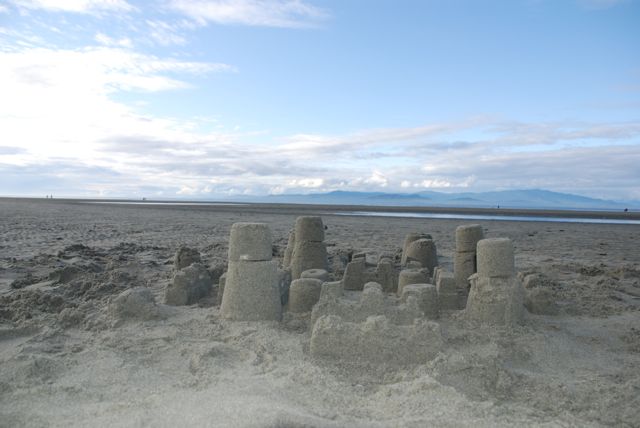
Beach days ahead

School’s out for summer!

I worked frantically for the last few weeks to get a non-ficton draft off to Annick and a fiction manuscript off to my agent, all in preparation for impending full-time motherhood.

I thought about putting this blog on hiatus for the summer, but I’ve since reconsidered. After all, this little site has kept me writing through long days of diaper changes and spoon feeding. I’ve typed posts one-handed while nursing and composed plenty of them in the park while pushing kids on swings. I’ve been grateful to have an outlet that kept me writing, even when it was just a few lines.

This year, with both kids in school full-time, I’ve posted a little less often. Not because I’ve been feeling less creative, but because — finally! — I’ve had more time to work on longer projects.

All of this is to say… who the heck knows what will happen here this summer!?! I may disappear for days on end, or I may be here in every spare moment, happy to scribble a sentence or two.

sandcastles