Category Archives: Writing

Change is coming… or is it looming?

Remember that last semester of university? The thrill of finishing school combined with the knowledge that you might never again have regular, scheduled 2 p.m. naps?

I’m having similar flip-flopping feelings now. In six short months, both my kids will be in school full time. No more babies at home. I’ve already had three dreams in which I lose my son in the school building. In one, I was grocery shopping and suddenly realized I’d forgotten to pick him up. In another, I was volunteering with a group of older kids and I accidentally left him behind. Obviously, I’m having some separation anxiety.

On the other hand, there will be six hours (SIX!) of quiet in my house. EVERY DAY. If I want to get my hair cut, I will be able to do that without major advance childcare planning. If I want to go into a store filled with breakable items, I can do so without lecturing, glaring, or tooth gnashing. I will even be able to… gasp… write. Kind of even full-time. Or at least a lot less part-time than I’ve been writing for the past eight years.

And just as I had all sorts of plans upon leaving school (eg. make enough money to buy hardcover books, new shirts, and breakfast cereal*), I have plans now. So many plans that they are spilling out of my head onto scraps of paper and into random laptop files. I wake up at 5 in the morning with plans. I make plans in the shower. I make plans while listening to my son play three blind mice on the organ…

over…

and over…

and over again.

I have six more months to go. I have to calm down.

* I had unrealistic expectations for wages in the arts. I didn’t actually achieve any of these goals until I married someone in the sciences.

A chapter book waiting to happen

In northern Ontario last week, a truck containing $3 million of loonies and toonies crashed, spilling its loot all over the road. (True story.) This caused a chain-reaction crash in the opposite direction, and a candy truck also tipped onto the highway.

I’m guessing there was a pint-sized genius behind this crash. Can’t you see him? He’s sitting on a high stool before a massive computer screen. He’s created a graph showing all possible money truck/candy truck route intersections. Then, with the touch of a button, he makes something pop up on the road. Drivers swerve, tires screech. He cackles, from behind his screen. And meanwhile, his minions leap from the brush at the side of the highway and start scooping armfuls of treasure.

Pretty sure that’s how it happened.

Random thoughts and missed opportunities

ALWAYS, after a non-fiction book goes to the printer, I find some fact or idea I wish I’d included. For 50 Underwear Questions, there were two: the radiation-blocking shorts and the Playtex seamstresses sewing space suits.

I hadn’t had any regrets for Seeing Red… until yesterday.

I was driving home from a play last night, listening to Q, and there it was. A random point from astrophysicist Neil deGrasse Tyson:

We have blood based on iron, and therefore red. If we had blood based on copper, as crustaceans do, it would be green. When we cut ourselves, we would see green. So, would green therefore be our warning colour, and would stop lights be green?

Who woulda thunk there could be a connection between streetlights and blood?! Yeesh… now I’m going to have to write a whole new book.

Big news!

My friend Deryn Collier (who I know through our mutual friend Brandy, who I know because she went to high school with my sister — did you follow that?) has a new book coming out!

I am what is technically known as a “big chicken” and Deryn writes crime fiction, which I can’t usually read without biting my nails and getting nightmares. But I will be reading Confined Space.

I’ll be reading it the moment it comes out in June, from Simon & Schuster, and I can’t wait!

Check out the publisher’s blurb:

When respected ex–Canadian Forces commander Bern Fortin cuts short his military career to take a job as the coroner for a small mountain town in the heart of BC, he’s hoping to leave the past behind. Bern’s looking forward to a quiet life, but the memories of what he witnessed during his stints in Afghanistan and other war-torn countries haunt him still.

When the body of one of the workers is found floating in the huge bottle-washing tank at the local brewery, Bern is called in for a routine investigation. What first appears to be a tragic accident takes a menacing turn when the body of the worker’s girlfriend is discovered in a nearby field. Bern needs the help of brewery safety investigator Evie Chapelle, who, burdened by tragedies she might have prevented, is more determined than ever to keep her workers, and their tight-knit community, safe. Soon, Bern and Evie find themselves risking their jobs — and their lives — to uncover a killer hiding in a place where it is awfully hard to keep a secret.

Deryn Collier’s debut novel is a taut mystery full of suspense. Confined Space was shortlisted for the Arthur Ellis Award for best unpublished first crime novel by the Crime Writers of Canada.

Hmmm… a small, mountain town with a brewery. A place where you can’t keep a secret. Now, why does that sound so familiar?

Maybe I’ll send Deryn my big-haired grad picture and see if she can make me a character in book two.

Inspirational digs

I’m writing this from a house on the Sunshine Coast. In front of me, huge floor-to-ceiling windows show a few leaves, the top of one palm, and then ocean.

I love houses like this. I mean, I could never actually live in one, because of the whole rising-sea-levels and cataclysmic weather issues, but I do love visiting. And there’s something about writing and an ocean view that go together well, no?

My daughter has similar thoughts about the loft in this house. It’s a perfect little hideaway — a bed on the floor, a tiny window, and access by ladder. She called down, “attics are more inspiring than other floors, aren’t they?”

So true.

The break-up

I love spiral-bound notebooks. I love the smell and the weight of them. The light blue lines with the red margins. The cover patterns. I love choosing new ones at the drugstore.

On a bookshelf in my hallway, there’s a line-up of notebooks full of stories and scribbles. I can’t throw them away. What if I one day remember a rant I wrote about the need for better toilet seat design in public bathrooms and I NEED to use some of those sentences? Or, what if my descendants want to auction my memorabilia for millions of dollars? (Oh, shush. There’s no need to laugh that hard.)

Ever since I got my laptop, though, I’ve been using my notebook less and less. Random thoughts now go straight to twitter. Random rants to the blog. Coffee-shop writing is done hunkered in front of the screen.

It’s good, really. Except for when I open THAT DRAWER in my bedroom. The one where my most recent notebook sits. Every time that happens, I feel as if I cheated on a boyfriend, then left him unexpectedly, and I’ve just run into him at the supermarket.

Ouch. Sorry, dude…

Lessons in plot pacing… from a field mouse

This is my daughter’s summary of The Adventures of Danny the Meadow Mouse:

He got caught by an owl, but he escaped, but he’s lame, so he couldn’t get home, because he lives in a meadow, so now he lives with Peter Rabbit, but Peter Rabbit went out to get bark and he got caught in a snare, and I’m only 50% done, but these books end at 81%.

Phew. No wonder they end at only 81%. I mean, how much more action can Mr. Thornton W. Burgess fit into a single book?

I had forgotten all about this series until Grandma arrived at our house a few months ago with a stack of well-loved hardcovers. Now, my daughter’s filling in the blanks with her constant requests for Kindle downloads.

Soon, I’m going to have to re-read one and remember what I’m missing. Not to mention learn a few things about plot and tension. My books are completely lacking in the raptor and snare departments.

(By the way, I tried to find a cover image to include in this post. But the ones I found were yellow. These books are not supposed to be yellow. The covers have triangular patterns around the edges. Obviously. And if Google’s not going to match my memories properly, then I’m not downloading images.)

Fifty questions I didn’t ask

Look what arrived on my doorstep on Friday:

That’s right: 50 Climate Questions, by Peter Christie and illustrated by Ross Kinnaird. You will notice that it’s not written by me, and that’s because the only thing I know about climate science is that it freaks me out. Peter Christie, on the other hand, knows quite a lot. For example, he knows that Earth had a bad case of flatulence 4 billion years ago, he knows how climate and witch burnings are related (crazy, no?), and he knows why a mini-ice age helped Stradivari produce great violins.

You know what else is great about this book? Annick just sent me a cheque for use of the concept.

Now that’s even crazier than climactically affected witch burnings! From now on, I’m skipping all this tricky research and writing stuff. I’m gonna sell me some concepts.

Hackmatack!

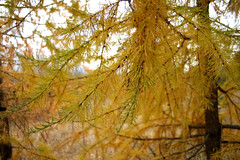
It is not an attack of severe coughing. No, it’s a tree. A Larix laricina, otherwise known as a tamarack larch. And, it’s the name of a reader’s choice award program in Nova Scotia, through which students will soon be reading copies of 50 Poisonous Questions.

Yay, hackmatack!

tamarack

I’ve been trying to learn if any parts of the hackmatack are poisonous, because I thought that would be such a fitting combination, but so far it seems a fairly benign sort of tree. Although, wikipedia does say it’s highly competitive.

Like me.

Pick me, pick me, students of Nova Scotia!

Um… I mean, after reading all the other worthy titles (I don’t know what they are yet) and giving the competition serious consideration. Then pick me. You know, if you want.

* Photo by withrow.

Pump up the info

From my Serendipity talk, and in continuation of last week’s excerpt, here are my top five ways for making non-fiction interesting. They work if you’re a writer (and a few more writers for adults could stand to adopt them). They work if you’re presenting information in the classroom. And they’re techniques to look for if you’re buying books for kids.

1. Use the Unexpected
By the time they’re seven or eight years old, kids have learned to expect certain things from their books:

  • They expect science experiments to be safe and adult-approved.
  • They expect history to be dull.
  • They expect important people to be respected.

So, give them some baking soda and a film canister and let them blow stuff up. Tell them gruesome stories, like the one about the ancient Chinese emperor who buried all the scholars… alive. Give your Mayan queen a Valley Girl accent, and treat historical icons like real people.

Who doesn’t like a surprise?

2. Question Everything
Questions are the language of children. I have two kids at home – they’re seven and five. They must ask me six billion questions a day. By three in the afternoon, I have no idea what I’m answering anymore. Then I find them eating chocolate cake a half hour before dinner and they say, “We asked… and you said yes!” This happens because they’ve asked me so many questions that my brain is no longer functioning.

Kids and questions… they’re like chocolate cake and ice cream.

There are three kinds of questions to incorporate in non-fiction:

  • Rhetorical questions, a matter of style
  • Questions that reflect exactly what the reader is wondering – the type of questions Jian Gomeshi uses in a great celebrity interview
  • Questions that can never be answered

You know all that CSI stuff about blood spatter? The spatter is on the left side, and the teardrop shapes are long and thin, so the guy was hit on the head quickly, on the right side.… You’ve seen it on TV, right? Well, ever ask yourself how scientists learned all that? The first guy to research it — he’s regarded as a rock star in CSI circles. And he learned by bopping rabbits on the head, and tracking the blood.

Justifiable? Well, that question is well outside the scope of Seeing Red. But I couldn’t resist at least raising the issue.

Questions are central to writing for kids. Ask the questions that interest them, then inspire them to ask more questions. You don’t need all the answers. Kids can decide for themselves. The important part is to keep them wondering.

3. Embrace the Ridiculous
Anyone can be silly. Write a list, and add something goofy to the middle of your list. Or simply point out the crazy parts of reality.

Want to hear how King Mithridates made his universal poison antidote, 2000 years ago? Here’s a possible recipe:

  • Squeeze poison from 50 plants
  • Boil a legless lizard
  • Extract musk from a beaver’s scent glands
  • Mix all of the above
  • Add honey ’til tasty

Mithridates was so worried about assassination that he spent years building up his immunity to all sorts of poisons. Then, when his Roman enemies finally attacked him, he swallowed poison to kill himself. And, of course, it didn’t work.

Point out how strange some people’s decisions are. When Alfred Nobel was researching dynamite, he blew up his brother, gave his dad a stroke, got kicked out of Stockholm, and kept working. Who does that?

In World War II, the Americans sent soldier to fight in the Pacific and issued them white jockey underwear. Well, flapping on a clothesline with a nice dark jungle in the background, their underwear was the perfect target for enemy fire. Jockey quickly switched to olive green undies, so clotheslines could go camouflage.

There is plenty of ridiculousness in history, and plenty in our everyday lives, and it’s not our jobs as adults to defend it. We don’t have to be serious. Why can point, and laugh, and say, “I know! It’s crazy!”

4. Use the Techniques of Fiction

  • Give your historical figures some character
  • Set the scene
  • Write dialogue

Now, I know that some books get slammed for fictionalizing historical figures with dialogue. You can check out the Mayan queen in Seeing Red and you’ll understand that I like to make it completely obvious when dialogue isn’t real. In 50 Poisonous Questions, there’s a prison doctor who tested poisons and antidotes on his prisoners. He did write poetry, but the “roses are red, violets are blue” verse which appears in his illustration is not one of his works.

The point is that incorporating narrative, or storytelling, in non-fiction will help kids absorb facts in a way that a list or a graph will never do. A story draws us in.

5. Be Inspiring
In all my books, my favorite stories are always about the people who changed the world.

In 50 Poisonous Questions, there’s a lady who found out that her neighborhood school was built on top of a toxic waste dump and she started a campaign, organized the local parents… she got the whole town moved. And she was a mom! Kids have no idea that moms (or kids) can change the world.

You know, you can even create change with your underwear.

My husband likes to ask people this question: Imagine you’re offered a free round-the-world trip, for as long as you want, as many stops as you want. There’s only one catch: anytime you’re actually travelling, on a plane, or on a boat, or on a train, every time you go through customs or flag a cab, you have to wear your underwear outside your pants. Would you take the trip?

(You would? Representatives from Flight Centre will be contacting you soon.)

Alright… an unrelated question. Are you wearing – right this minute – a corset and a floor length skirt?

No one?

How interesting. That might be because of Amelia Bloomer, who shocked all of New York by wearing her underwear in public.

I’m inspired by people who change the world. And I hope the kids who read my books get equally inspired.

There are enough boring things in life. We all have to brush our teeth and wash our faces and tie our shoes. That’s plenty of routine for anyone.

Learning should never be boring.